
There are very few places on earth that eCommerce doesn’t reach. It might surprise you to know that the first eCommerce store was launched in 1982, when petrol cost less that 40p a litre, ET had just been released, and wedding knees up classic “Come On Eileen” was the biggest hit of the year.
The first eCommerce store was the Boston Computer Exchange and sold used computers.
In 1995 eBay (formerly AuctionWeb) and Amazon were launched, shortly followed by Alibaba. As people became more accustomed to buying online, and payments became more secure with platforms such as PayPal, Stripe and GooglePay, more businesses evolved their websites from general business information, to somewhere people could actually purchase products and services from their sofas, their beds or on the move via their mobile.
Roll forwards to 2020, and global retail e-commerce sales reached £3074 billion. This is predicted to keep on rockin’ and grow by another £511 billion in 2021, as technology expands its reach even further around the world.
eCommerce has become even more important since the start of 2020, when the COVID-19 pandemic meant large numbers of people were confined to their home. In the first month of the pandemic, online shopping rates surged dramatically, growing 129% week-on-week in UK and Europe.
 What the growth of eCommerce means for business owners
 What the growth of eCommerce means for business owners
For those already with an eCommerce website, it hopefully means more sales (so long as your supply chains were not affected too badly during the pandemic!).
Whilst this is the news that every business wants in theory, in practice it also means that eCommerce systems need to be working harder and smarter, so that business owners don’t become overwhelmed with the day to day of running an eCommerce business at the expense of developing business strategy.
The thing is, most people don’t buy on the first visit and, even if they do, they may not come back to buy again.
It’s down to you as the site owner to:
- Understand what your customer wants
- Not only that, know WHY they want it! What problem are they solving, what need are they fulfilling?
- What stage are they at now? Are they ready to buy??? Do they need some of the solutions explaining?
- Guide your visitor, helping them to understand what the options are, and what works best for them.
THIS is how you EXCEL at eCommerce! But… How can you do that for nearly EVERY customer? How can you SCALE this?…
Don’t worry… eCommerce Marketing Automation has your back!
Introducing eCommerce Marketing Automation
eCommerce Marketing Automation is a process of using software to deliver targeted messaging to potential customers, based on ‘triggers’ and workflows that are predefined.
Why is Marketing Automation eCommerce’s BFF?
eCommerce is completely different to traditional retail in that it’s very rare that there is one person dealing with one customer at any one time.
In a physical shop, if your customer has questions about a product, they could ask your staff for advice. A good customer rep would likely ask them about their needs and guide them to the best choice for that need.
 Now, imagine having a physical store with nobody to help answer customer’s queries? Do you think it’d get less sales than a shop that had really well trained staff who helped customers to get the right product for them? Of course, right?!
This is essentially what marketing automation does… So one way to look at this is it’s your in-store sales staff for your eCommerce site!
Not only can marketing automation help to guide customers to the best product for them, it can also help increase average basket value…
For example, in a physical shop they might be training sales assistants to promote special offers or placing products such as batteries or accessories next to the tills (who hasn’t been tempted by special offer novelty socks or a slab size chocolate bar while queuing?)
Greater profits can be made in the mid to long term by putting some welly into marketing automation for eCommerce at the start.
Essentially, marketing automation for eCommerce – when carried out correctly – saves time, makes the business more money and prevents an online business from becoming a confusing network of manual processes, open to human error.
Types of eCommerce Marketing Automation
There are many forms of eCommerce marketing automation, and marketing platforms are continually adding shiny new features and foxy functionalities in order that businesses are able to further improve how they interact with their customers.
Marketing automation approaches are not a one-size-fits all, it needs to be tailored to your business, but some example types are:
Email Marketing Automation – where email messages are sent automatically depending on the customer’s interests and what they might be looking for in the future. This might include both transactional and marketing emails.
Chatbot Marketing Automation – using chatbots on websites at set points when customers are browsing, to improve the customer experience and increase conversion rates. They can also be used on some social media platforms, especially Facebook.
Website Interaction Triggers – using information on how people are working their way through an eCommerce website to customise marketing messages to their interests, with the objective of increasing the number and value of sales as well as keeping their interest with content that doesn’t have them hitting the back button.
Paid Advertising Automation – Paid Advertising Automation often involves using retargeting campaigns to deliver high-conversion ads to customers based on their interaction on your website. For example, if someone visits a specific product or category on your site but doesn’t convert, showing ads on Facebook for that product with either more information, or perhaps a discount code, to ‘nudge’ them to a sale.
These are the four main categories of eCommerce marketing automation… But to work best, these tactics should be used within a broader strategy, combining different marketing automation tactics to deliver smart marketing and boost sales.
Email Marketing Automation – Non Junk Email.
What is email marketing automation?
Email marketing automation enables marketers and business owners to create email workflows that automatically send emails to people when specific triggers have been activated.
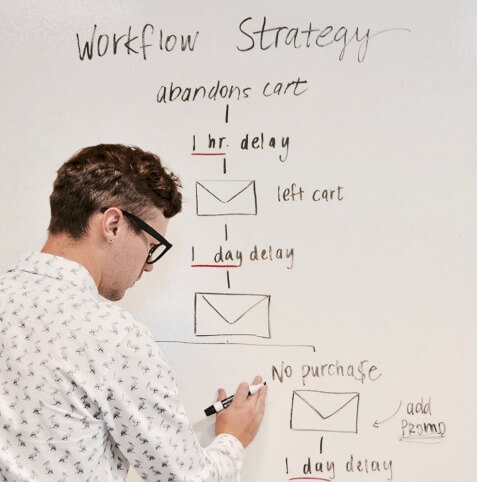 These workflows take into account both the action that acted as a trigger, and data about the individual behind the email address. This combined information means a business owner can create the most relevant email message, personal to the person receiving the email.
Email personalisation has proved to boost transaction rates and revenue. Experian have claimed that personalised email marketing had 29% more unique open rates and a 41% higher unique click rate than generic email marketing. For triggered email campaigns using email marketing automation, personalisation resulted in double the transaction rates compared with those not personalised to the individual.
Experian’s research also showed that, in the same way, personalised subject lines delivered a 26% higher unique open rate overall. So basically, if you’re not personalising your emails, you’re writing those emails for you and not for them.
Single email marketing automations vs customer journeys
From there, simple one step email marketing automations based on actions could be put in place. This might include:
- Someone signs up to join a website’s mailing list. A week after they join that mailing list, they automatically get an email about the business’s products or services, and what the upcoming special offers and/or events are.
- If a customer opens an email on the latest product releases for an underwear company, and clicks on the link for thongs, a week later they get another email just about thongs (and what an email that would be.)
- A week after an order dispatch notification is sent, the customer receives an email requesting a review of that product.
However, instead of these one-off automations, a business might look at creating an email marketing automation customer journey. This is where there are multiple emails triggered (or not triggered) based on actions, in a row.
This is an example of a simple customer journey in email marketing automation.
- A customer receives an ‘order sent’ notification, having made a purchase.
- A week after this email has been received, they get an email asking them for a review for the product with the options being thumbs up in which case they go to the website to leave a review, or a thumbs down in which case they go to a feedback form.
- If the customer gives a business the thumbs up, then a week later they get sent a ‘recommend us to a friend’ email, inviting them to forward the email – containing all the latest special offers – to a friend.
This is a basic journey where an action triggers an email, and no action triggers no emails. However, you can get more complicated customer journeys where there are emails sent depending on if there is, or is not, an action carried out or triggered.
This is an example of a more complicated email marketing automation customer journey:
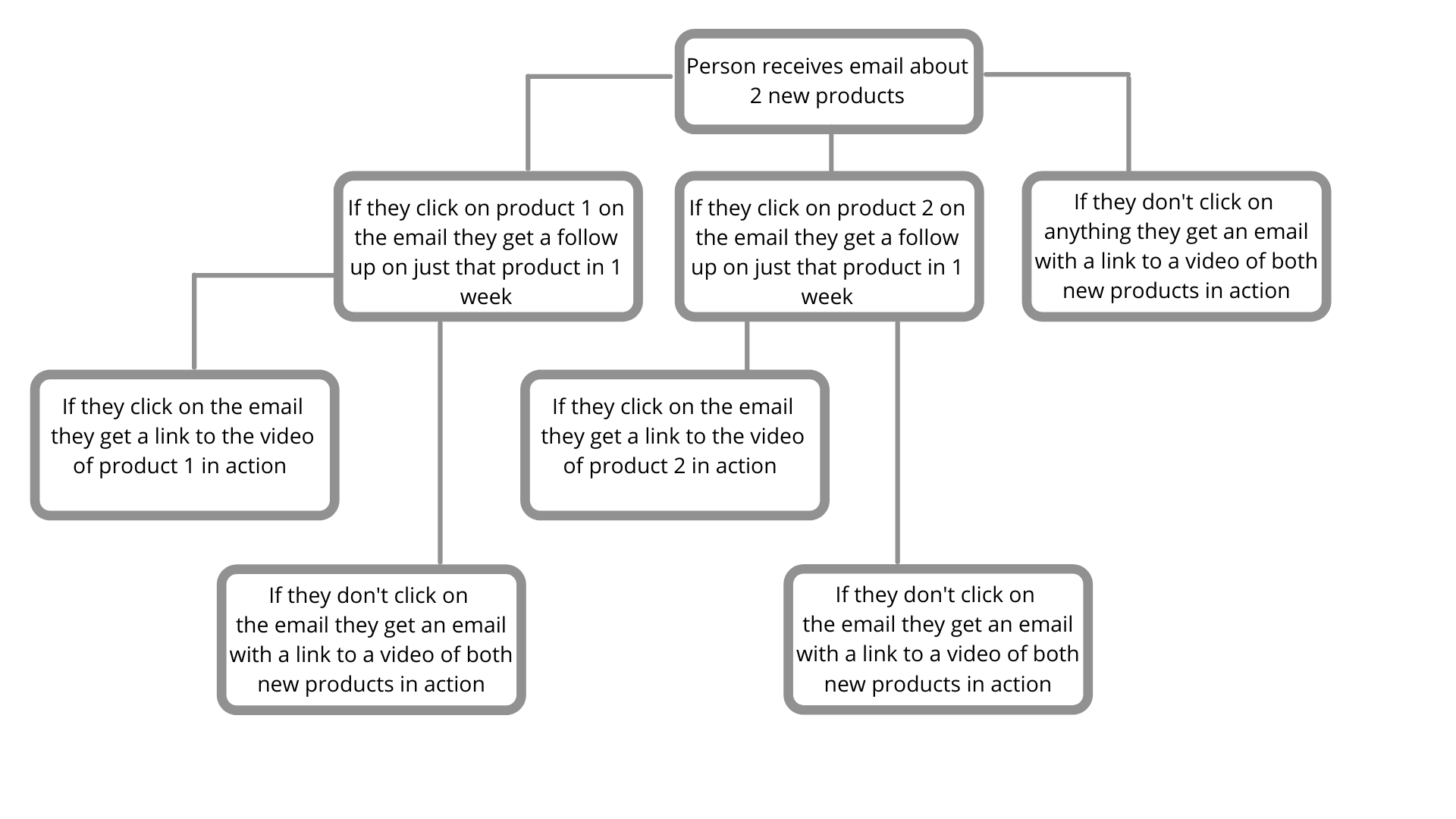 Even this, however, is a bit basic, in that it doesn’t take into account if a customer buys at any point during all this (which ideally they would). For example, what happens if the customer bought the product after the first email, but they went on to continue to get email advertising something they’d already purchased for the next week.
Whilst they wouldn’t necessarily send the product back based on getting the follow-up emails, they might well think less of the brand and the buying experience.
The worst-case scenario would be their getting irritated to the point of unsubscribing, at which point it wouldn’t matter how good your email messaging was because they wouldn’t get it. It’s really important that customer journeys are mapped out to include buying activity to not just get, but keep, customers.
Using customer data in email marketing automation – being nosey pays.
As mentioned, it’s not triggers alone that determine email activity. Looking at the information you have on your subscribers is an essential part of eCommerce email marketing automation.
As luck would have it, I have a brilliant recent example of this. I signed up to the mailing list of a well-known food delivery app on the theory that whilst they don’t currently deliver in my area, they would expand, and by opting in I would be notified if or when this happens.
However, what has happened is that every fortnight they send me a discount code on an email for my first order. They are still not active in my area, yet I am clearly stuck at the ‘new customer’ stage of their email marketing automation customer journey with no consideration given to my location. I cannot progress through the sales funnel simply because they don’t deliver to my postcode, yet the emails continue, plus it’s making me hangry (hungry angry).
What they could be doing is segmenting their list of subscribers to ensure that only those that live in an area they operate in receive that email. If my postcode is added to their list, I could get an automated email to let me know they are now operating in my area, and then I could commence getting the emails again and grab myself a KFC.
This would decrease the chance of my opting out of their email communications and increase my chance of ordering when they start operating in my area.
Chatbot Marketing Automation – Sales Not Sci-fi
What is chatbot marketing automation?
 The concept of chatbots is nothing new and can be seen in many a 1960’s documentary or blockbuster films, exploring the possibility and danger of artificial intelligence (usually in lycra or leather).
They’re an automated way of answering questions in a conversation-like format, but at scale: Explaining products and services, prompting people to buy and for more complex products or services, progressing people to the next stage of the buying process i.e., getting a live demo.
They respond to questions using a sophisticated series of algorithms that interprets and identifies what the prospect or customer has said, infers what they mean or want, and determines an appropriate response or set of responses, based on all of the information they have available.
Why use chatbot marketing automation?
Consumer Intelligence experts J.D. Power found that live chat has become the leading online preferred contact method for digital customers. A surprising 42% of customers preferred live chat with just 23% preferring email and 16% social media or forums.
But having live chat available all of the time isn’t a feasible option for anyone but enormous corporations, and even the big companies tend to have ‘office hours.’ Let’s face it, recruiting people to answer questions from insomniacs and clubbers at 2am isn’t money well spent.
Chatbot marketing automation isn’t the same as having a real-life person, but when used in an efficient way, business owners with insight into what their customers are likely to want can answer questions around the clock using a chatbot that removes the need for a customer to stumble around an FAQs list or lose their buying momentum.
Types of chatbot
There are two main types of chatbot:
- Simple chatbots use pre-written keywords, phrases, and questions that they are programmed to understand. Each programmed command must be written separately using regular expressions or other forms of string analysis.
- Smart chatbots rely on artificial intelligence when interacting with users. Instead of pre-prepared answers, the chatbot responds with suggestions on the topic. Additionally, all of the words and questions that customers use are recorded for later processing.
Businesses looking to make use of chatbot marketing automation can choose from a wide range of ‘out of the box’ solutions or developing a bespoke one from scratch. There are pros and cons each way, but it is suggested that whichever route is taken; to provide a great user experience on your website, using a chatbot superstar when setting up chatbot marketing is a good idea.
There are articles out there stating that ‘anyone can make a chatbot’ with no programming knowledge and minimal technical skill. However, a chatbot that proves more frustrating than helpful will most likely do more harm than good when nurturing customers through the sales journey. Making your own chatbot is a bit like wiring your own house – could go up in flames.
Real life examples of chatbot marketing automation
A range of different businesses in different industries use chatbots. Here are a few of the more prominent ones. They both make use of social media chatbots to engage with customers.
Roof Ai is a chatbot that helps real-estate marketers interact with leads via social media. The super smart chatbot identifies a potential house shopper via Facebook, then starts a friendly conversation with them in the style of a real person.
Based on what the lead goes on to say, the Roof Ai chatbot prompts home shoppers to provide a little more information, and then automatically assigns the lead to a sales agent. So, in this instance the chatbot doesn’t actually answer questions per se, but it gets all of the information it needs to be able to pass the lead on to the most relevant person according to needs, location, etc.
Dominos created a chatbot in Facebook, with the key aim of making ordering pizza easier and more accessible as well as all out cheesy yumminess. Once a Dominos account is paired with a Facebook account, it enables the customer to create a new order, reorder a previous order, and track their food delivery, all in a message window alongside the messages to your mum and your friends. The fact that it’s in Facebook negates the need to open a new platform, making it easier to access, and the informal friendly tone guides you to a hot delicious pizza.
Both of these are examples based in social media, but a similar approach on an eCommerce website could help answer questions, point people to an appropriate service or product, or put their question to the most relevant person.
Website Interaction Triggers – We Can See You….
What are website interaction triggers?
For an eCommerce website, the website is the linchpin of the whole operation – that’s where the money comes from! Getting people to a website is only a tiny part of the battle though. Once they’re there they aren’t definitely going to get out their virtual wallets and spend their virtual dosh. A business needs to guide them through the buying process.
Website interaction triggers are sometimes through activity on the website alone – for example pop ups at key points. Often, they involve website interaction triggering an action in other marketing areas such as email marketing automation, Pay Per Click (PPC) ads or social media adverts.
Here are some examples of website interaction triggers where the customer interacts with the website alone:
When a customer reaches a webpage about a product that is part of a multibuy offer, a pop-up appears informing the customer that this product is part of an offer that gives them 3 products for £20, for example. It then gives them the link to the page with a list of the products in this offer and the date in which they need to purchase by.
After someone has been reading a blog on a set topic for more than 1 minute – for example, a sportswear company might have a blog post on the best hikes in the UK – the website prompts them to look at their newly released range of hiking shoes and boots (you like hiking? What a coincidence, we sell hiking boots!)
Or, for more complex set-ups using marketing automation platforms, website visits can trigger email or SMS marketing sequences using if/then rules, for example:
- If a visitor you have the email of has been looking at a certain category of products…
- Then send them an email comparing the products
- Then wait 1 day
- If they have not bought the product after 1 day
- Then send them a 5% or 10% off coupon
- Used well, website triggers coupled with other forms of marketing automation can give your eCommerce business the edge, increasing profits & customer lifetime value significantly

PPC Marketing Automation – Put Your Money Where Your Mouse Is
What is PPC and paid marketing automation?
Pay Per Click (PPC) marketing is essentially any advert displayed online where the business pays an amount for every time someone clicks on their advert. This contrasts with the lesser used ‘Pay Per View’ or ‘Pay Per Impression,’ where the business pays for every person that simply sees their advert.
The key advantage to PPC is that a business only pays for actual bums on website seats. However, the challenges include making sure that the right person, i.e., someone who might well buy the product or service – clicks on the advert.
The most commonly used paid marketing sources are Internet giants Google and Facebook. There are 5 billion searches carried out every day on Google and 1.6 billion people globally are connected to a small business via Facebook
Remarketing For eCommerce
Paid marketing automation gives your business the ability to use much smarter targeting than simply adding a selection of demographic targeting parameters… For example, retargeting campaigns can be set-up to deliver high-conversion ads to customers based on their interaction on your website.
Imagine someone visits a specific product or category on your site, but doesn’t convert? Annoying, right? You don’t have their email, they’re GONE.
Not so fast though! If you set-up the Facebook pixel and have a smart retargeting campaign set-up, then you can show ads on Facebook for that product, perhaps with either more information, or even a discount code, to ‘nudge’ them to a sale.
It doesn’t stop there, either. This is just one (basic) example of remarketing campaigns. Another option would be to cross-sell related products of product accessories, or even ask for reviews.
There are many, many remarketing tactics but, as ever, the tactics should fit within a STRATEGY. Without a solid remarketing strategy, tactics will be inefficient and disconnected from the rest of your marketing efforts… booooo!
Full Marketing Automation – Bringing It All Together.
 Full Marketing Automation – Bringing It All Together.
What is full marketing automation?
Full marketing integration is taking everything above:
- Chatbot marketing automation,
- Website interaction triggers that utilise…
- … Email marketing automation
- All this is combined with smart retargeting ads on platforms like Facebook to bring it together, creating a full, integrated
- customer journey that prompts browsers to become buyers (and ideally repeat customers!).
Phew! That’s a lot of work though, Right?! Yup! But it’s worth it!
Examples of full marketing automations
A good example of a basic full marketing automation is a scenario most people have been in at some time in their online shopping life, the abandoned shopping cart.
This is an almost painful situation for anyone with an eCommerce business: There is an individual interested enough in a product or service that they’ve actually got to the point of adding it to a cart to buy but then, for whatever reason, didn’t actually purchase it. There’s any number of reasons that this could happen.
- They were interrupted or lost signal.
- They didn’t have their method of payment on them i.e., card details, payment platform log in details etc.
- Something or someone put them off at the last minute. This might include delivery times or costs, they’ve decided to wait until payday, they’ve decided to shop around first, it turns out that wasn’t the model their spouse or child wanted, etc.
- You just didn’t convince them! Your content, your layout or your marketing just didn’t cut the mustard in talking them into spending their well earned wonga.
- They are still considering their options!
A full marketing automation ‘customer journey’ – using all of the marketing automations previously mentioned – might look similar to below:
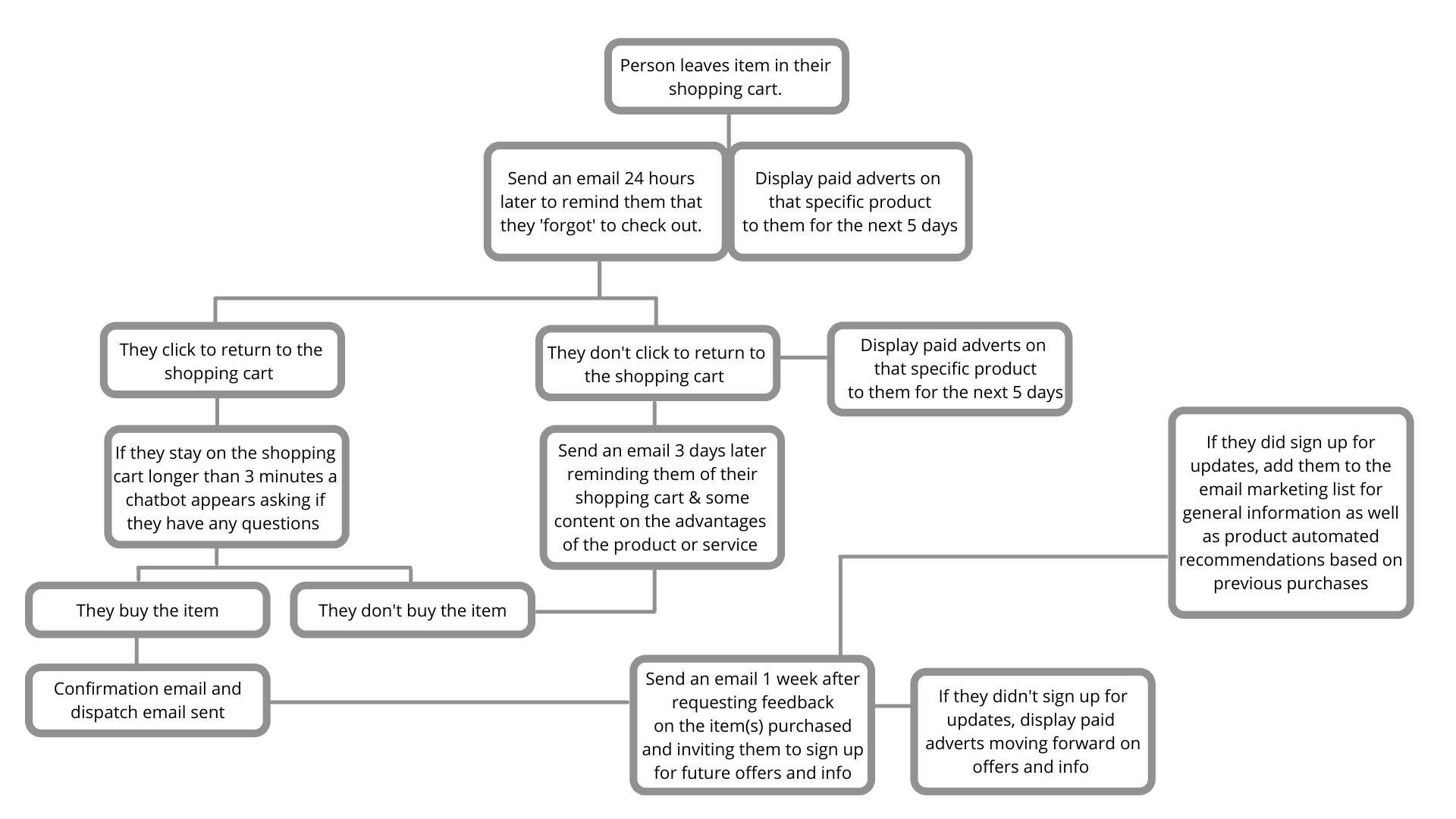
You can see a mix of marketing automations there, and they interact with each other to ensure a much slicker customer journey and increase the chances of a visitor converting to a purchase, as well as optimise marketing spend.
This is just one example of a full marketing automation for an eCommerce website. There can be any number of full marketing automations with all or any forms of eCommerce marketing automation integrated with each other.
Which Marketing Automation Software Is Best For eCommerce? Decisions, Decisions….
As you’d expect, there is a wide range of marketing automation software, and they all have their pros and cons. A lot of businesses choose to use a mix of different marketing tools and integrate them to work together.
Marketing automation experts will be best placed to set you straight on what meets your needs, but whether you’re looking to create a successful eCommerce business or make better use of marketing automation for an existing eCommerce business, choosing the right mix of tools is going to save you time and potentially money at a later date.
Here are a couple of the leading eCommerce tools that work well in eCommerce marketing automation:
HubSpot. This is one of the leading names and brands in marketing automation software. Being an established tool and one of the bigger players in the arena, HubSpot offers a full range of sales, marketing, CMS, and CRM tools. It enables eCom business owners and marketers to integrate and automate most of a business’s online marketing automations.
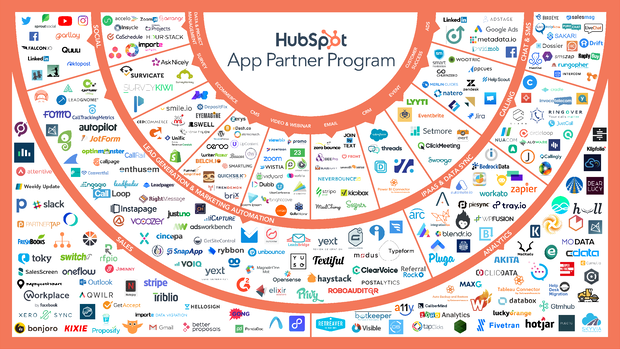
In addition to this, it offers a huge selection of integrations – they had to literally cram them into a diagram. If there is a tool that is preferred, already in use, or industry specific, it is quite likely that HubSpot will be able to work alongside it.
The pricing is scalable depending on the size of your business and adaptable to growth, however it is a premium tool, with a price to match. Many of the features are easy to use and there is a massive community of users and forums, giving you advice and information, as well as the ‘HubSpot Academy’ with tutorials and webinars.
Klaviyo is a cloud-based email marketing and automation tool for eCommerce businesses. It prides itself on being ‘customer focused’ and provides a lot of data segmentation tools to enable more customised email content and customer journeys. In addition, it enables you to send personalised SMS messages to customers.
Like HubSpot, it integrates with a wide range of different tools and whilst it isn’t a Content Management System in itself, it integrates with all the leading eCommerce platforms including WooCommerce (the leading eCommerce plugin for the big boss of CRM platforms – WordPress) and Shopify. Pricing is scalable and based on the number of emails or SMS messages you want to send. You can choose to just to email, just do SMS, or do a combination of both.
Klaviyo is a great option if budgets are too tight for Hubspot.
Mailchimp is one of the more established email marketing and automation tools; over a decade older than Klaviyo. This doesn’t necessarily mean it’s better, but it’s a bigger name that is possibly better known and widely used for that reason.
When it comes to both segmentation and workflows/customer journeys, this cheeky monkey is still rolling out some features that already exist in Klaviyo and HubSpot. It has a good range of out of the box integrations and pricing is scalable. There are options in how you want to scale your pricing – either by the number of subscribers or the number of emails. You can send SMS via Mailchimp, but it isn’t as prominent a feature as it is in Klaviyo.
Mailchimp is great for email marketing in general, but in our opinion Hubspot & Klaviyo win for their eCommerce marketing automation features.
In Summary – we’re nearly done.
You could argue that ECommerce marketing automation isn’t an essential part of an eCommerce business, but we’d reply that it’s an essential part of a successful one!
Businesses should regularly take stock of current processes and where they might be improved. There is frequently a way in which marketing automation technology can step in to create a more personal, more efficient, and more enjoyable customer journey for all.
Need Help With eCommerce Marketing Automation?
The Alternative Agency are eCommerce specialists, and we’re also Hubspot & Klaviyo partners. We know what eCommerce sites need in terms of marketing automation, and we’re here to help you nail this, increase customer lifetime value, reduce abandoned carts, and increase profits… Let’s chat!